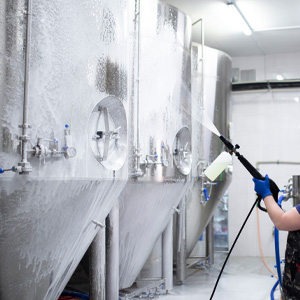
Cleanliness also plays an important role in industrial companies – not only in terms of the quality of the manufactured goods, but also for the safety of the employees. In each business, there is a unique set of materials which are exposed to various types of soiling, which means that the ideal cleaning concept has to be identified in each individual case.
Foam allows the safe and exact application of a cleaner to the area that is to be cleaned. Furthermore, foam prolongs the working time and prevents the premature drying of the cleaner. Additionally, foam can protect sensitive surfaces from scratches.
In machine cleaning and high-pressure cleaning, too much foam is a problem as it reduces cleaning power and disturbs the cleaning process. Thus, low-foaming surfactants with high cleaning power are used.
Hydrotropic surfactants improve the solubility of nonionic surfactants in surface cleaners, especially in cleaner concentrates.
With the right product, perfume oils or hydrophobic solvents can be clearly solubilised.
Depending on product type, dosage system and application, the viscosity of a cleaner must be in the “right” range and therefore needs to be either decreased or increased.
Degreasing means effectively removing hydrophobic dirt (e.g. oils and fats). Nonionic surfactants are often used in cleaners since they possess a high fat-dissolving power.
The wetting of dirt and surfaces is the first and critical step in the cleaning process. Special surfactants with fast wetting properties speed up the cleaning of surfaces, especially if hydrophobic (greasy and/or polymer-based) surfaces are to be cleaned.
Cleaning means removing dirt from a surface first and subsequently dispersing all dirt components in water to prevent redeposition. Since dirt usually contains oils and fats, it is very important to use effective emulsifiers. These products also help to incorporate a hydrophobic solvent into the cleaner formulation to enhance the cleaning effect.
Shiny surfaces can appear hazy and dull if water condensation causes fogging. In the right concentration, special surfactants and polymers used in cleaners can prevent fogging.
Static charges on surfaces can cause electric shocks that may damage electronic devices. Furthermore, static charges may accelerate the re-soiling of surfaces after cleaning. Surfactants with antistatic properties help to prevent static charges on surfaces.
Metal surfaces can be damaged by acidic cleaners, especially if strong acids are used. Surfactants with anti-corrosion properties prevent corrosion during the cleaning process.