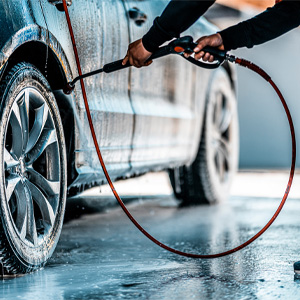
Wheels are composed of parts made from different materials, such as galvanised wheel bolts, steel or aluminium rims and rubber tyres. This is why cleaning agents must be compatible with all these different materials. Besides, they are required to quickly and effectively remove stubborn dirt such as brake dust, tar and rust.
Foam allows the easy and safe application of wheel cleaners. Furthermore, foam prolongs the working time and prevents the premature drying of the wheel cleaner.
Hydrotropic surfactants improve the solubility of nonionic surfactants in wheel cleaners, especially in cleaner concentrates.
With the right product, perfume oils and hydrophobic solvents can be clearly solubilised. Especially in acidic wheel cleaners, these products can help to solubilise different ingredients, for example surfactants with anti-corrosion properties.
Degreasing means effectively removing hydrophobic dirt (e.g. oils and fats). Nonionic surfactants are often used in wheel cleaners since they possess a high fat-dissolving power.
The wetting of dirt and surfaces is the first and critical step in the cleaning process. Special surfactants with fast wetting properties speed up the cleaning of surfaces.
Cleaning means removing dirt from a wheel surface first and subsequently dispersing all dirt components in water to prevent redeposition. Since dirt usually contains oils and fats, it is very important to use surfactants that are able to emulsify these components effectively.
Static charges may accelerate the re-soiling of surfaces after cleaning. Surfactants with antistatic properties help to prevent static charges on surfaces.
Metal surfaces can be damaged by acidic wheel cleaners. Especially zinc coatings on wheel bolts and cleaning systems can rapidly be corroded by acids. Surfactants with anti-corrosion properties prevent corrosion during the cleaning process.