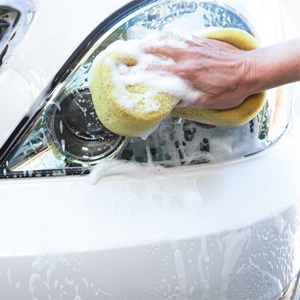
A car wash not only lets the car’s paint shine but also guarantees the safety of the vehicle and preserves the materials. Optimum cleaning and care therefore require special ingredients.
Foam allows the easy and safe application of cleaners. Especially in the car cleaning industry, foam is preferred to prolong the working time and to prevent the premature drying of the car cleaner. Furthermore, foam can protect the coating from scratches.
Sometimes, foam is not desired in car cleaning. In this case, special low-foaming surfactants can be used.
Hydrotropic surfactants improve the solubility of nonionic surfactants in cleaners, especially in cleaner concentrates.
With the right product, high amounts of perfume oils or hydrophobic solvents can be clearly solubilised.
Depending on product type, dosage system and application, the viscosity of a cleaner must be in the “right” range and therefore needs to be either decreased or increased.
Degreasing means effectively removing hydrophobic dirt (e.g. oils and fats) or protective wax layers. Nonionic surfactants are often used in car cleaners since they possess a high fat-dissolving power.
The wetting of dirt and surfaces is the first and critical step in the cleaning process. Special surfactants with fast wetting properties speed up the cleaning, especially if hydrophobic surfaces are to be cleaned.
Emulsifiers play an important role not only when greasy soil is to be emulsified in cleaning solutions, but also when cleaning agents contain a high proportion of perfume oil or when a hydrophobic solvent is to be incorporated to enhance the cleaning effect.
Shiny surfaces can appear hazy and dull if water condensation causes fogging. In the right concentration, special surfactants and polymers used in cleaners can prevent fogging.
Static charges on surfaces may accelerate the re-soiling of surfaces after cleaning, e.g. by attracting dust. Surfactants with antistatic properties help to prevent static charges on surfaces.
Metal surfaces can be damaged by acidic wheel cleaners: for example, zinc coatings on wheel bolts and cleaning systems can be rapidly corroded by acids. Surfactants with anti-corrosion properties prevent corrosion during the cleaning process. On plastic parts, stress corrosion cracking can be caused by cleaner ingredients. Therefore, suitable products need to be chosen.