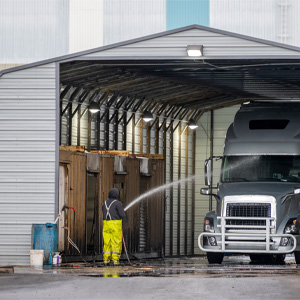
Commercial vehicles used for the transportation of persons or goods must meet high demands. Cleaning and care play a crucial role – whether for the clear visibility of advertising printed on a truck tarpaulin or for the cleanliness of the interior and thus the comfort of the passengers on board a bus.
Especially on large surfaces of commercial vehicles, foam can be easily applied usin foam generators. Foam prolongs the working time and avoids the premature drying of the cleaner. Furthermore, foam can protect sensitive surfaces from scratches.
Sometimes, foam is not desired in vehicle cleaning. In this case, special low-foaming surfactants can be used.
Hydrotropic surfactants improve the solubility of nonionic surfactants in cleaners, especially in highly alkaline cleaner concentrates.
With the right product, perfume oils or hydrophobic solvents can be clearly solubilised.
Depending on product type, dosage system and application, the viscosity of a cleaner must be in the “right” range and therefore needs to be either decreased or increased.
Degreasing means effectively removing hydrophobic dirt (e.g. oils and fats) from surfaces. In cleaners for commercial vehicles, nonionic surfactants are favoured due to their high oil- and fat-dissolving power.
The wetting of dirt and surfaces is the first and critical step in the cleaning process. Special surfactants with fast wetting properties speed up the cleaning, especially if hydrophobic (greasy and/or polymer-based) surfaces are to be cleaned.
Emulsifiers play an important role not only when greasy soil is to be emulsified in cleaning solutions, but also when a high proportion of perfume oil or a hydrophobic solvent is to be incorporated into the cleaner.
Everyone knows fogged glass surfaces and mirrors. Especially while driving in the dark and in dense traffic, this can turn out to be a real safety issue. Fogging can be prevented by using a combination of special surfactants and polymers in cleaners.
Static charges on surfaces may accelerate the re-soiling of surfaces after cleaning, e.g. by attracting dust. Surfactants with antistatic properties help to prevent static charges on surfaces.
Metal surfaces can be damaged by acidic cleaners, especially if strong acids are used. Surfactants with anti-corrosion properties prevent corrosion during the cleaning process.