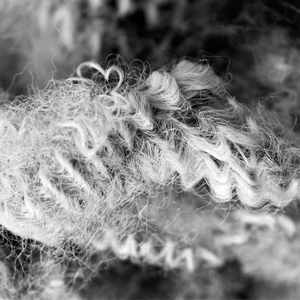
Zschimmer & Schwarz offers a range of various spin finishes for the production of staple fibres for technical and hygienic nonwovens. Additionally, the field of fibre-fill production, for example for bedding, furniture and warm clothing, is ideally covered, as is the production of short-cut fibres. The extensive product portfolio is rounded off by finishes for subsequent application to fibres.
Staple fibres produced from PP (Polypropylene) or PES (Polyester) can be processed into needle punched nonwovens, among other things. Fibres which have been manufactured with Zschimmer & Schwarz products fulfil a particularly high quality standard: very good processing properties are a must. Depending on their intended use, they also meet the other high requirements, such as low emissions.
When used in geotextiles, for example, their main purpose is to stabilise the ground, for instance during road construction work.
On the other hand, in the automotive industry, low fogging behaviour and a minimal tendency to yellowing are essential for automotive carpets and headliners.
The use of staple fibres in carpets and mats requires high wear resistance, good antistatic properties and a "living appearance".
The water-jet process, also known as hydro entanglement, spunlace or hydro-jet, is a mechanical binding process in which the fibres or filaments are entangled by means of high-pressure water jets instead of, for example, steel needles (as in the case of needle-punched nonwovens). One advantage of these spunlaced nonwovens provides a soft textile handle.
Common spunlaced products are:
Thermobonded staple fibre nonwovens are frequently used in the hygiene sector, where they are mostly known as the top sheet (uppermost covering layer in a diaper) or as the ADL (acquisition distribution layer inside the diaper). Due to their voluminous structure, they have a special softness and, thanks to capillary forces, a pronounced absorption capacity.
The variety of products satisfies all customer wishes and requirements: whether hydrophilic with FDA compliance, super-hydrophilic or – for special applications – finishing as after-treatment in order to provide hydrophilic fibres a hydrophobic character – our spin finishes for staple fibre production impress all along the line.
During the production of PES fibre-fill, the main focus is on the specific feel and bulk volume. Here, the fibre softness depends on the final application: for example, particularly soft fibres are used for pillow fillings, while fibres with a harsh handle are used for filling furniture.
Typical applications for fibre-fill:
Cushions, pillows, clothes, furniture, duvets, sleeping bags, jackets, mattresses
Specific requirements for fibre-fill:
High specific volume, elastic expansion/compression pressure, thermal insulation, washability, smoothness
Textile yarns made of PES staple fibres can be used for cotton- and wool-type fabrics, additionally PAN fibres are also being frequently used. Yarn spinning is carried out by means of ring, rotor spinning (OE) or airjet spinning. Special applications, such as drinking filters made of PP, are often produced by DREF spinning.
Short-cut fibres have a length of just a few millimetres, no crimping and are mainly produced from PP and PES. The main focus here is on good fibre distribution.
Typical applications for short-cut fibres:
The tow for cigarette filters is manufactured from cellulose acetate (CA) or polypropylene (PP).
The spin finish enables not only a reliable spinning process, but also fulfils the high quality requirements for cigarette filters.
Glass fibres are used for the production of yarns and tow, or as short-cut fibres. Yarns have a diameter of ≤ 9 μm per fibre, tows a diameter of ≥ 10 μm per fibre. Short-cut fibres are mainly used for the production of nonwoven mats and fibre-reinforced composite materials.