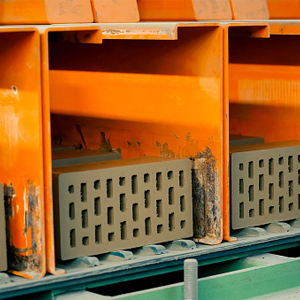
BURN-OUT AIDS / POROSITY-INDUCING AGENTS The use of porosity-inducing agents serves for the specific adjustment of the pore size, pore volume and pore distribution. A typical application field is the production of abrasive tools. Fibrous porosity-inducing agents can be used to reduce cracks and shrinkage, and to bring about faster de-watering.
The use of porosity-inducing agents serves for the specific adjustment of the pore size, pore volume and pore distribution. A typical application field is the production of abrasive tools. Fibrous porosity-inducing agents can be used to reduce cracks and shrinkage, and to bring about faster de-watering.
The employment of dispersants allows the reduction of water content in ceramic dispersions. Deflocculants help to save valuable water and energy resources. The slip properties (viscosity, thixotropic behaviour, structural viscosity, dilatancy, rheopexy and Newtonian flow behaviour) can be adjusted according to the customer’s requirements.
During preparation of slips, foam can form through surface-active substances and also through the mechanical energy input. Our antifoam agents prevent foam formation during preparation or, respectively, immediately destroy foam that has already formed.
The efficiency of the pressure casting process, as well as the cost effectiveness of conventional slip casting, are dependent on the output per unit time, which in turn depends on the casting rate.
The use of filtration agents leads to the agglomeration of fine particles, and a more even de-watering of the casting slip is the result. A regular density and a uniform shrinkage allow the production of a homogeneous cast that is free from internal stresses. To a large extent, separation and sedimentation phenomena are prevented. Furthermore, filtration agents confer good interlocking at transitions from hollow casting to core casting, and better removal from the mould.
Biocides are required for the application of organic additives and/or raw materials to counteract their deterioration caused by micro organisms such as bacteria, yeasts or fungi, and consequently to guarantee long-term stability.
The addition of wetting agents promotes reduction of surface tension of the preparation water, causing a better dispersion of the body. With the help of wetting agents, the plasticity of clay-containing ramming and extruded bodies having the same amount of preparation water can be increased or, respectively, the amount of preparation water can be decreased while maintaining the same plasticity. Wetting agents make the forward motion of the extruded body more uniform over the entire cross-section. The use of wetting agents further makes it possible to incorporate compounds that are normally difficult to wet, such as for example carbon, more readily and the result is a more homogeneous composition of the batch.
Plasticisers, acting as swelling agents, increase the plasticity of a body. These additives absorb a portion of the available preparation water and increase the workability of the body, thanks to their swelling ability. This makes it possible to substitute plastic clay components by non-plastic materials. Plasticisers are used in pressing and ramming mixes as well as in extruded bodies. On account of extrusion body surfaces being dull in many cases, it is recommended to combine plasticisers with pressing agents and lubricants.
Pressing agents and lubricants are used in pressing and in plastic bodies, where they optimise the shaping properties. They reduce internal friction of the body, leading to a more homogeneous compaction and, thus, contributing to a reduction of microstructural tensions. Friction between the article and the mould wall is reduced. An increase in effective mould life is, therefore, possible. The sticking tendencies of the body to the mould wall can also be decreased. In the compaction of spray granulates, pressing agents can further act as softeners, so that during pressing a simple breakdown of the residual granulate structures becomes possible.
If a composition does not contain sufficient plastic raw materials with binding properties, the temporary binders can be utilised to increase the green and dry breaking strength of the body, as well as to improve the edge strength. This is necessary for the handling ability of the shaped articles in the subsequent technological processes and the safe intra-company transport. Temporary binders can be used for plastic shaping via extrusion, dry pressing as well as for the production of spray dried or build-up granulates.