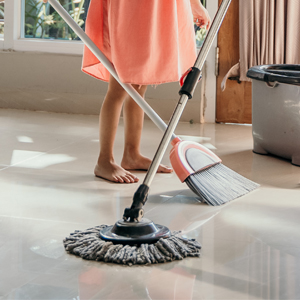
The cleaning requirements for different types of flooring are just as diverse as the materials themselves. There is a great difference between the caring cleaning of delicate wood floors and the targeted elimination of stains on carpets. Foaming capacity, cleaning power, sustainability and special finishes, such as antistatic properties, are factors that vary depending on the respective application area.
For manual carpet cleaning, it is recommended to use a high-foaming product that creates a “dry” foam to prevent the carpet from soaking. To delay re-soiling, the cleaner should dry without leaving any sticky residue.
Hydrotropic surfactants improve the solubility of nonionic surfactants in floor and carpet cleaners.
Depending on product type, dosage system and application, the viscosity of a cleaner must be in the “right” range and therefore needs to be either decreased or increased.
Degreasing means completely removing hydrophobic dirt (e.g. oils and fats). In floor cleaners and in spray extraction cleaners for carpets, nonionic surfactants are used since they possess a high fat-dissolving power.
Wetting dirt and surfaces is the first and critical step in the cleaning process. Fast wetting speeds up the cleaning process. In floor cleaning and in spray extraction cleaning of carpets, the use of special wetting agents is necessary, especially if hydrophobic, polymer-based surfaces are to be cleaned.
Cleaning floors means removing dirt from the surface and subsequently dispersing all dirt components in water. If not dispersed properly, the dirt redeposits on the floor. Surfactants with emulsifying properties are needed to remove oily and fatty dirt.
Static charges on carpets and floors can cause electric shocks that may damage electronic devices. Furthermore, static charges can accelerate the re-soiling of floors and carpets. Surfactants with antistatic properties help to avoid static charges on floors and carpets.